

7 Signs Your Business Has Outgrown Shared Hosting
- October 2026
Your business has outgrown shared hosting when your website slows down under normal traffic, you keep hitting resource limits, or downtime starts costing you actual sales. The practical next step for most Malaysian businesses at that point is a cloud server.
Shared hosting works well when you are starting out, but it was never built to carry a growing business forever. The tricky part is knowing exactly when you have crossed that line, rather than just assuming a faster laptop or a cache plugin will fix things
Shared hosting works well when you are starting out, but it was never built to carry a growing business forever. The tricky part is knowing exactly when you have crossed that line, rather than just assuming a faster laptop or a cache plugin will fix things
Key Takeaways
- Consistent slowdowns, resource limit warnings and rising downtime are the clearest signs shared hosting can no longer keep up with your business.
- Shared hosting splits server resources between many websites, so one busy neighbour or a traffic spike on your own site can affect performance for everyone.
- A cloud server in Malaysia gives your business dedicated resources, more control and infrastructure that can scale as your traffic grows.
- Moving to a cloud server does not have to mean starting from scratch. A staged migration with proper planning can reduce disruption.
Your Site Slows Down at the Worst Times
If your website crawls whenever a promotion goes live or traffic picks up, that is not bad luck. It is a resource problem.
On shared hosting, your website sits on the same physical server as dozens or even hundreds of other sites. When any of them experiences a traffic surge, everyone sharing that server can feel the slowdown, including you.
A business that depends on its website for sales cannot afford for its busiest moments to also be its slowest ones. This is usually the first sign that a dedicated environment, such as a cloud server Malaysia businesses can rely on for consistent performance, makes more sense than staying on a shared plan.
Those "Resource Limit" Emails Won't Stop
Getting the occasional notice from your host is normal. Getting them every month is not.
Shared hosting plans typically cap usage across a few key areas:
- CPU usage
- Memory (RAM)
- Storage space
- Number of files your site can have (on some plans)
Once you hit those caps, your host may throttle your site, suspend certain functions or send warning after warning asking you to upgrade or optimise.
If you find yourself constantly deleting files, compressing images or disabling plugins just to stay under a limit, your business has simply outgrown what that plan was designed for.
A cloud server removes that ceiling by allocating resources specifically to your workload rather than sharing them across a pool of unrelated websites.
Downtime Is Starting to Cost You Real Money
A few minutes of downtime used to be an inconvenience. Now it means missed orders, abandoned carts and customers who quietly move on to a competitor.
As your business grows, the cost of every outage grows with it. What was tolerable when you had a handful of daily visitors becomes a genuine problem when your site is central to how customers reach you, pay you or book with you.
Your Admin Dashboard Feels Like Wading Through Mud
If logging into your CMS, updating a product page or generating a report now takes noticeably longer than it used to, that is a backend resource issue.
A sluggish admin panel slows your team down every single day, even outside of peak traffic. Over time, that adds up to lost productivity across your whole business, not just a frustrating few minutes here and there.
A sluggish admin panel slows your team down every single day, even outside of peak traffic. Over time, that adds up to lost productivity across your whole business, not just a frustrating few minutes here and there.
Checkout Problems During Your Busiest Sales Periods
Nothing stings quite like losing sales during the exact moment you worked hardest to generate traffic.
If your checkout process slows down, times out or throws errors whenever a campaign or seasonal sale drives a spike in visitors, shared hosting is very likely the bottleneck. Payment gateways, inventory checks and order confirmations all demand processing power, and shared environments were not built to prioritise that during high demand.
A cloud server gives your business dedicated resources that stay available specifically for you, rather than competing with whatever else happens to be busy on the same server at that moment.
You Need Control Shared Hosting Won't Give You
As businesses mature, their technical needs often become more specific. Shared hosting is intentionally limited, and hosts lock down server settings to keep the environment stable for everyone using it, which is reasonable, but it can also mean missing out on a few things:
Custom Software and Configurations
You may need a particular software version or a custom configuration that your shared plan simply does not support.
Server-Level Settings
Shared environments are locked down for everyone’s stability, so you cannot adjust server-level settings to suit how your business actually operates.
Persistent Background Processes
Running processes that need to stay active in the background is usually restricted by default on shared hosting.
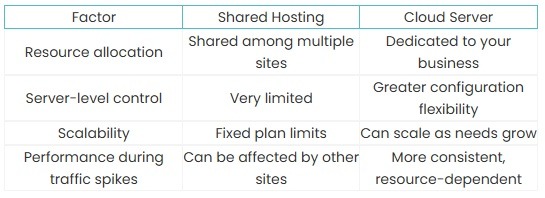
Factor
Shared Hosting
Cloud Server
Resource allocation
Shared among multiple sites
Dedicated to your business
Server-level control
Very limited
Greater configuration flexibility
Scalability
Fixed plan limits
Can scale as needs grow
Performance during traffic spikes
Can be affected by other sites
More consistent, resource-dependent
If your team is regularly asking for changes your host cannot or will not accommodate, that is a strong indicator you need an environment built around your business rather than a generic one shared with strangers.
Growing Data and Security Expectations
As a business collects more customer data through orders, bookings or account sign-ups, the expectations around how that data is stored and protected naturally increase.
Shared hosting environments offer less isolation between accounts by design, since resources and sometimes underlying infrastructure are shared. For businesses that need more control over configurations, access and data handling, that lack of separation can become a genuine concern rather than a minor technicality.
Moving to a cloud server allows for a more isolated setup, which can make it easier to manage security practices tailored to your specific business rather than relying on a one-size-fits-all shared configuration.
What Happens After Shared Hosting
Recognising these signs is half the job; the next step is a realistic upgrade path.
For most growing Malaysian businesses, that means a cloud server, not a dedicated one, which is usually more than a mid-sized business needs. It offers dedicated resources, more configuration flexibility and room to scale, without the cost of managing standalone hardware.
With proper planning, covering data migration, DNS changes and testing, the transition need not be disruptive.
If these signs sound familiar, it’s worth having a proper conversation about your hosting setup.
Ready to make the move? Talk to MyCloud about a cloud server built for your business.
Our Related Offerings
Browse through our solutions that align with this topic. From cloud technology to IT support, we provide everything you need to move your business forward.
Enterprise Managed Virtual Private Servers (VPS) Hosting
Crafted to meet local and global business needs.
Business Data Backup Solutions
We provide secure, remote data backup solutions to keep your business protected
Disaster Recovery Services
Ensuring your operations remain connected no matter the challenge.
Suggested Articles
Don’t miss out on valuable tips, trends, and success stories in cloud computing. Visit our blog for expert articles, in-depth guides, and more to help you grow your business with cloud technology